
If you’ve ever looked at a product box, furniture listing, or vehicle specification and felt confused by measurements, you’re not alone. These three basic dimensions appear everywhere in daily life, but they are often misunderstood.
In this guide, you’ll learn how object dimensions work in a simple, practical way so you can read sizes confidently in real-world situations.
What Are Length, Width, and Height?
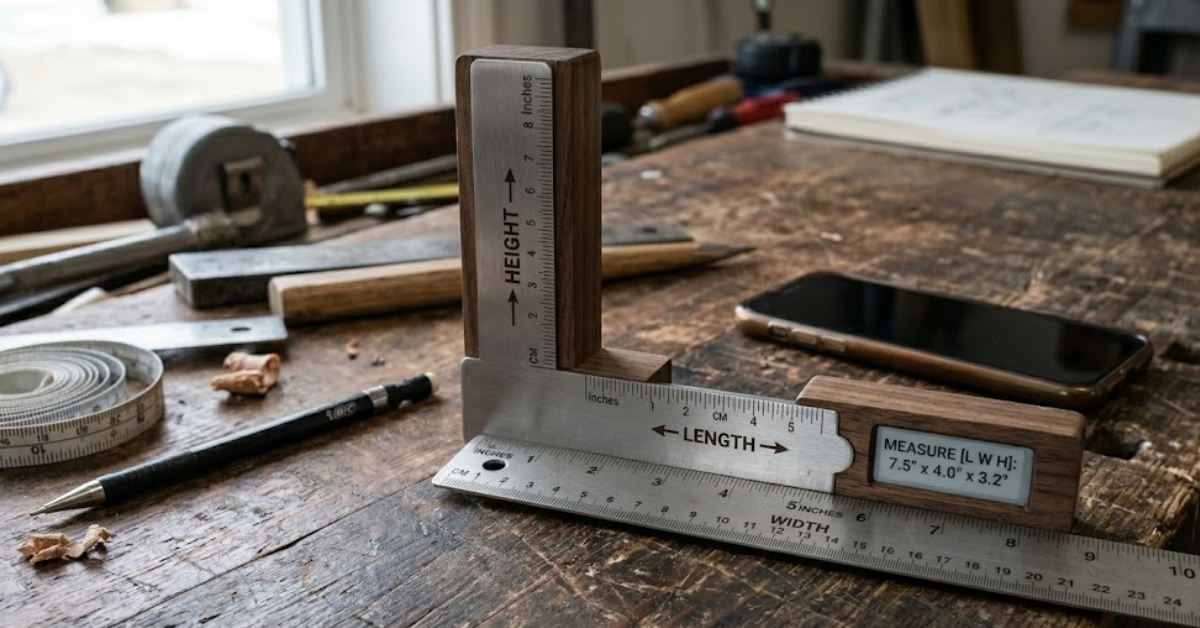
Every 3D object is described using three measurements that define its size and shape.
Here’s the simple breakdown:
- Length: the longest side of an object
- Width: the side-to-side measurement
- Height: how tall the object is from bottom to top
These measurements are used in packaging, construction, design, and manufacturing.
Understanding the Order of Dimensions
One common source of confusion is the order in which measurements are written.
The general format is:
- Length (longest side)
- Width (side-to-side)
- Height (vertical measurement)
However, in some industries like construction or shipping, the order may vary. That’s why context always matters when reading size information.
Box Dimensions in Real Life
Product packaging often uses this format to describe size.
For example:
A shoe box listed as 30 × 20 × 12 cm means:
- Length = 30 cm
- Width = 20 cm
- Height = 12 cm
This format is important for:
- shipping calculations
- storage planning
- online shopping accuracy
Correct interpretation ensures you don’t misjudge product size.
Depth vs Height Explained
Sometimes, you may see “depth” instead of height.
- Depth: how far something extends inward
- Height: how tall it stands vertically
In many cases, these terms are used interchangeably depending on perspective.
Calculating Space and Volume
When working with space, different formulas apply:
Floor area:
Length × Width
Volume:
Length × Width × Height
These calculations are useful for:
- room planning
- storage estimation
- construction design
- packaging and logistics
Vehicle Dimensions Explained
Car specifications often list all three measurements to describe size and space.
Here are some examples:
Tesla Model Y
- Length: ~4751 mm
- Width: ~1921 mm
- Height: ~1624 mm
Tesla Model 3
- Length: ~4694 mm
- Width: ~1849 mm
- Height: ~1443 mm
Cybertruck
- Length: ~5683 mm
- Width: ~2032 mm
- Height: ~1796 mm
Volvo XC60
- Length: ~4708 mm
- Width: ~1902 mm
- Height: ~1658 mm
Volkswagen Tiguan
- Length: ~4539 mm
- Width: ~1839 mm
- Height: ~1665 mm
Audi Q5
- Length: ~4682 mm
- Width: ~1893 mm
- Height: ~1662 mm
Toyota RAV4
- Length: ~4600 mm
- Width: ~1855 mm
- Height: ~1685 mm
Mazda CX-5
- Length: ~4575 mm
- Width: ~1845 mm
- Height: ~1680 mm
BMW X3
- Length: ~4708 mm
- Width: ~1891 mm
- Height: ~1676 mm
These measurements help compare vehicle size, interior space, and parking suitability.
Why Dimensions Matter
Understanding object dimensions helps you:
- choose furniture and appliances correctly
- understand shipping and packaging sizes
- compare vehicles accurately
- plan spaces efficiently
- avoid measurement mistakes
It is a simple concept, but extremely useful in everyday life.
Common Mistakes People Make
People often get confused by:
- mixing up width and height
- ignoring measurement units
- assuming all industries follow the same order
- forgetting depth in storage-related objects
Once you understand the logic, reading dimensions becomes much easier.
FAQs
1. What is the correct order of dimensions?
Usually length, width, then height, but it can vary by industry.
2. Is depth the same as height?
Often yes, depending on how the object is viewed.
3. How do you calculate volume?
Multiply all three dimensions together.
4. Why are dimensions important in cars?
They help compare size, space, and usability.
5. Can I use dimensions for square footage?
No, square footage uses only length × width.
Conclusion
Understanding basic object dimensions makes it easier to interpret sizes in everyday life. Whether you’re reading packaging details, comparing vehicles, or planning space, these measurements help you make better decisions.
Once you understand how dimensions work, reading size specifications becomes quick and intuitive.