If you’ve ever tried to follow a recipe or measure ingredients and got stuck on conversions, you’re not alone. One of the most confusing parts is figuring out how volume turns into weight. That’s exactly where a milliliters to grams conversion calculator becomes useful.
Instead of guessing, this tool helps you convert liquid measurements (milliliters) into weight (grams) based on density. In this guide, we’ll break down how the conversion works, why it’s not always the same for every ingredient, and how you can use a milliliters to grams conversion calculator correctly in real-life cooking, baking, and science situations.
What Is a Milliliters to Grams Conversion Calculator?
A milliliters to grams conversion calculator is a tool that converts liquid volume into weight. It’s commonly used in:
- Cooking and baking
- Nutrition tracking
- Chemistry experiments
- Medicine dosing
- Food production
The key idea is simple: milliliters measure volume, while grams measure mass. The conversion depends on the density of the substance you’re measuring.
Why Milliliters and Grams Are Not Always Equal
Many people assume milliliters and grams are the same, but that’s only true for water under standard conditions.
Here’s the basic rule:
- 1 milliliter of water = 1 gram
- Other liquids = different weights based on density
For example:
- Milk is slightly heavier than water
- Oil is lighter than water
- Honey is much heavier than both
That’s why a milliliters to grams conversion calculator is necessary—it adjusts for these differences automatically.
How the Conversion Formula Works
To understand how a milliliters to grams conversion calculator works behind the scenes, you need one simple formula:
- Grams = Milliliters × Density
Where density is usually measured in grams per milliliter (g/mL).
Example:
- Water (density = 1 g/mL)
- 100 mL × 1 = 100 grams
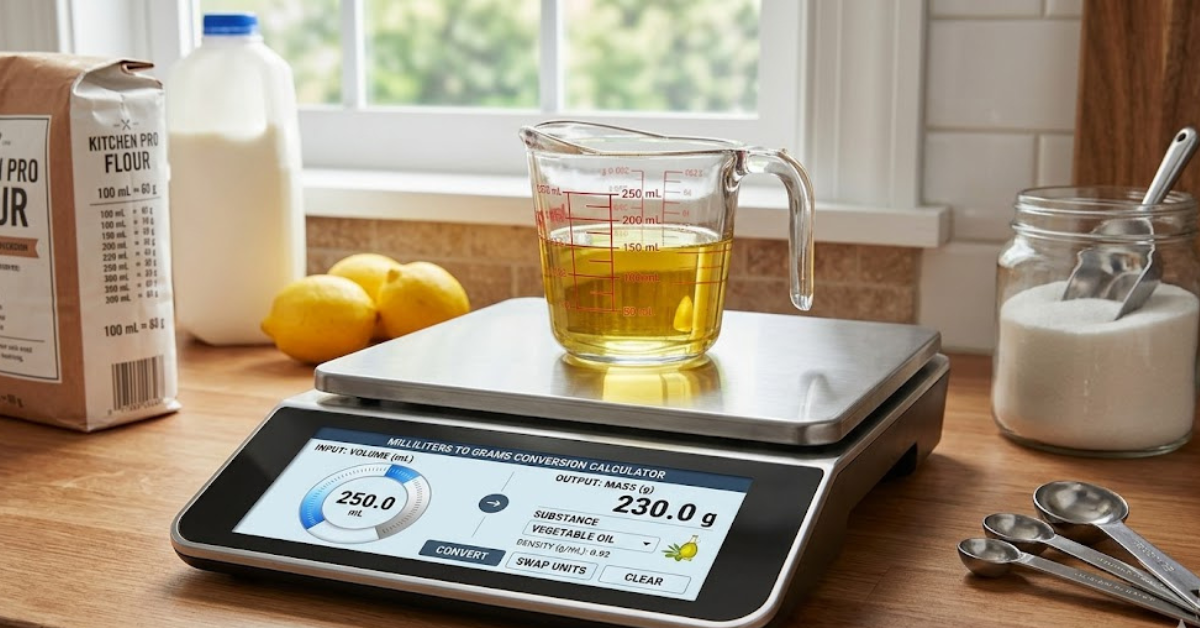
- Olive oil (density ≈ 0.92 g/mL)
- 100 mL × 0.92 = 92 grams
- Honey (density ≈ 1.42 g/mL)
- 100 mL × 1.42 = 142 grams
This shows why the same volume can have very different weights.
How to Use a Milliliters to Grams Conversion Calculator
Using a milliliters to grams conversion calculator is simple and usually follows these steps:
- Enter the volume in milliliters
- Select or input the ingredient type
- The tool applies the density value
- You instantly get the weight in grams
This removes guesswork and is especially helpful when precision matters.
Common Liquid Conversions (Real-World Examples)
Let’s look at everyday ingredients to understand better:
Water
- 100 mL = 100 g
- 250 mL = 250 g
Milk
- 100 mL ≈ 103 g
- Slightly heavier due to fats and proteins
Cooking Oil
- 100 mL ≈ 92 g
- Lighter than water
Flour (mixed/loose approximation)
- 100 mL ≈ 50–60 g depending on packing
These differences show why a milliliters to grams conversion calculator is far more reliable than manual guessing.
Why Density Matters in Conversions
Density is the hidden factor in every conversion. It tells you how tightly matter is packed inside a substance.
Higher density means:
- More weight in the same volume
Lower density means:
- Less weight in the same volume
That’s why oils float on water and honey sinks—density differences directly affect the results from a milliliters to grams conversion calculator.
When You Should Use a Conversion Calculator
A milliliter to gram conversion calculator is especially useful when:
- Following baking recipes that require precision
- Measuring liquids for dieting or nutrition plans
- Working in labs or science experiments
- Scaling recipes up or down
- Converting international recipe measurements
Even small errors can affect results, especially in baking or chemistry.
Tips for Accurate Conversions
To get the most accurate results, keep these tips in mind:
- Always check the ingredient type
- Use standard density values when available
- Avoid guessing conversions for thick or mixed liquids
- Use level measurements (not rounded or packed unless specified)
- Double-check results when precision is important
These habits make any milliliter to gram conversion calculator more effective.
Common Mistakes to Avoid
Many people run into errors when converting manually. Here are the most common ones:
- Assuming all liquids weigh the same
- Ignoring density differences
- Using volume tools for weight-only recipes
- Overpacking dry ingredients when measuring in milliliters
- Mixing metric systems incorrectly
Avoiding these mistakes improves accuracy significantly.
FAQs
1. Is 1 milliliter always equal to 1 gram?
No, only water has a 1:1 ratio under normal conditions. Other substances vary based on density.
2. Why do I need a milliliter to gram conversion calculator?
Because different ingredients have different densities, making manual conversion inaccurate.
3. Can I use the same conversion for all liquids?
No, oils, milk, honey, and water all convert differently.
4. What is the easiest way to convert milliliters to grams?
Use a calculator that includes ingredient density for accurate results.
5. Is ml to grams conversion used in cooking?
Yes, especially in baking, where precision is important.
Conclusion
Understanding liquid-to-weight conversion becomes much easier once you know how density affects measurements. A milliliters to grams conversion calculator takes the guesswork out of cooking, science, and everyday measurements by giving accurate, instant results.
Now that you understand how conversions work, you can confidently measure ingredients without confusion or errors. Whether you’re baking, cooking, or experimenting, using a reliable milliliters to grams conversion calculator ensures consistency and precision every time.