Understanding mm to m conversion is one of the most basic but important skills in measurement. Whether you are working on school math, engineering drawings, construction plans, or DIY projects, knowing how to convert millimeters into meters helps you interpret dimensions correctly and avoid mistakes.
The good news is that the conversion is extremely simple once you understand the relationship between millimeters and meters. In this guide, we will break everything down in a clear, practical, and easy-to-follow way.
What is MM to M Conversion?
The mm to m conversion refers to changing a measurement from millimeters (mm) to meters (m). These are both units in the metric system, but they represent very different scales.
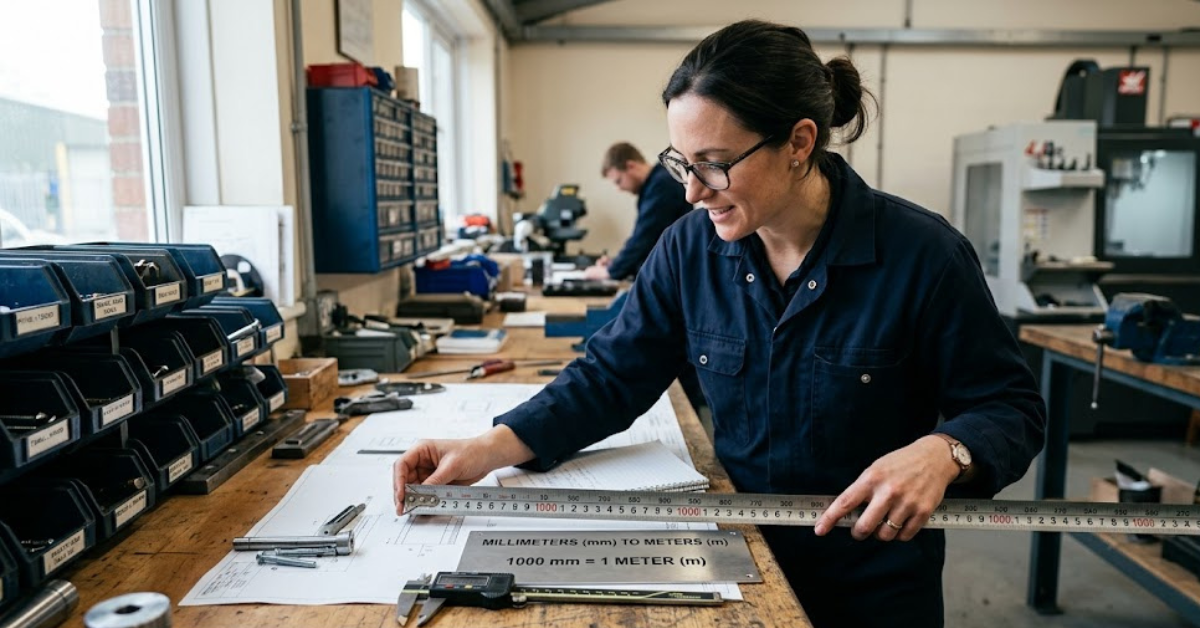
- 1 meter (m) = 1000 millimeters (mm)
- Therefore, to convert mm to m, you divide by 1000
This simple rule is the foundation of all conversions between these two units.
How to Convert MM to M (Simple Formula)
The formula is straightforward:
Meter = Millimeter ÷ 1000
So whenever you want to convert mm to m, just divide the number by 1000.
Example Calculation
If you are trying to convert 1000 mm to m:
1000 ÷ 1000 = 1 meter
This means 1000 mm equals 1 m.
Common MM to Meter Conversions
Here are some frequently used values to help you understand better:
1 mm to meter
1 ÷ 1000 = 0.001 meter
10 mm to meter
10 ÷ 1000 = 0.01 meter
100 mm to meter
100 ÷ 1000 = 0.1 meter
1000 mm to meter
1000 ÷ 1000 = 1 meter
0.5 mm to meter
0.5 ÷ 1000 = 0.0005 meter
2 mm to meter
2 ÷ 1000 = 0.002 meter
3 mm to meter
3 ÷ 1000 = 0.003 meter
4 mm to meter
4 ÷ 1000 = 0.004 meter
5 mm to meter
5 ÷ 1000 = 0.005 meter
20 mm to meter
20 ÷ 1000 = 0.02 meter
25 mm to meter
25 ÷ 1000 = 0.025 meter
30 mm to meter
30 ÷ 1000 = 0.03 meter
50 mm to meter
50 ÷ 1000 = 0.05 meter
300 mm to meter
300 ÷ 1000 = 0.3 meter
These examples show how quickly values shrink when converting from millimeters to meters.
Why MM to Meter Conversion is Important
Understanding convert mm to meter is useful in many real-world situations.
Construction and Engineering
Blueprints often use millimeters for precision, while larger measurements are expressed in meters.
Education
Students frequently solve math and physics problems involving unit conversions.
Manufacturing and Design
Accurate measurements are essential when creating machine parts or product designs.
Everyday Use
From measuring furniture to home improvement projects, conversions help ensure accuracy.
Quick Conversion Trick
If you want a fast mental shortcut:
- Move the decimal point three places to the left
For example:
- 100 mm → 0.1 meter
- 25 mm → 0.025 meter
This trick works for all mm to m conversion cases.
Step-by-Step Method to Convert MM to Meter
If you are new to conversions, follow this simple process:
- Write down the millimeter value
- Divide the number by 1000
- Place the decimal point correctly
- Write the final answer in meters
This method ensures accuracy every time.
Real-Life Understanding of MM and Meter
To better understand scale:
- 1 mm is about the thickness of a credit card
- 1 m is about the height of a door
This comparison helps visualize how small millimeters are compared to meters.
FAQs
What is mm to m conversion?
It is the process of converting millimeters into meters using division by 1000.
How do I convert mm to meter?
Simply divide the millimeter value by 1000.
What is 1 mm to meter?
1 mm equals 0.001 meters.
What is 100 mm to meter?
100 mm equals 0.1 meters.
What is 1000 mm to meter?
1000 mm equals 1 meter.
Why do we divide by 1000 in mm to m conversion?
Because 1 meter contains 1000 millimeters.
Conclusion
The mm to m conversion is a simple but essential skill in math, science, and real-world applications. By remembering that 1 meter equals 1000 millimeters, you can easily convert any value by dividing by 1000.
With practice, convert mm to m becomes quick and automatic, helping you handle measurements with confidence in education, construction, and everyday life.