Understanding unit conversions is an essential part of mathematics and everyday problem-solving. One of the most common conversions is between kilometers and meters. Whether you are studying, traveling, or working with measurements, knowing how this conversion works makes calculations much easier.
In this guide, we’ll explain the formula, step-by-step method, and real-life examples so you can confidently convert kilometers into meters.
What Is Kilometer to Meter Conversion?
The metric system is based on powers of 10, which makes conversions simple and consistent.
Basic Relationship
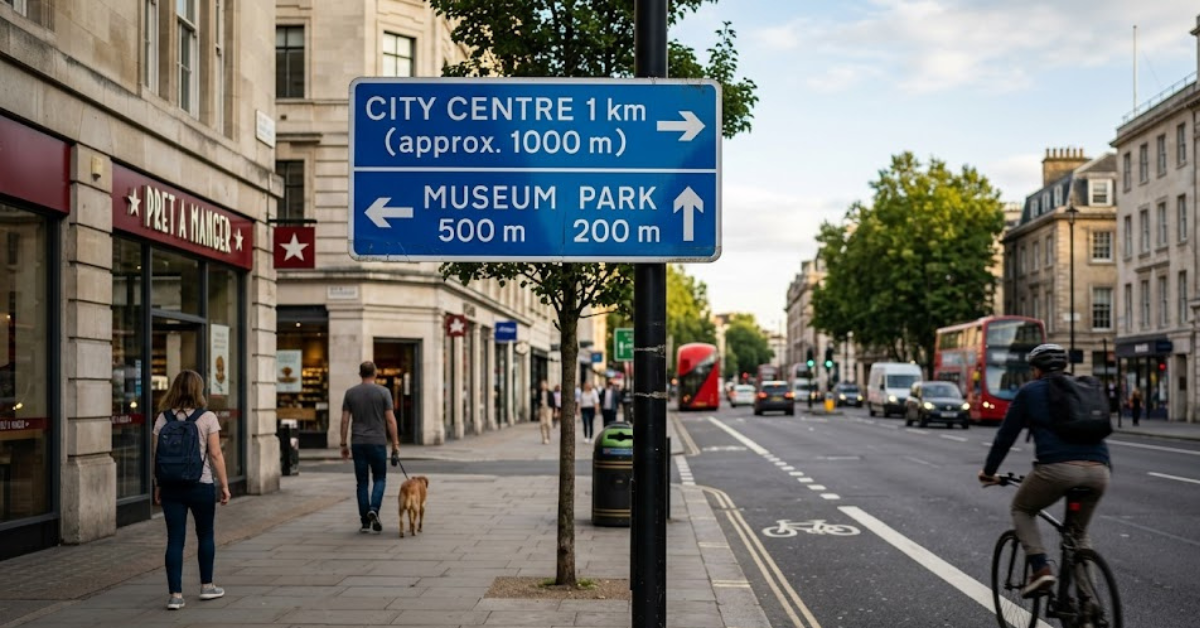
1 kilometer (km) = 1000 meters (m)
This means that to change kilometers into meters, you simply multiply by 1000.
Formula
Meters = Kilometers × 1000
How to Convert Kilometers to Meters
The process is very simple and always follows the same rule.
Step-by-Step Method
- Take the value in kilometers
- Multiply it by 1000
- Write the result in meters
Example
- 3 km × 1000 = 3000 meter
- 7 km × 1000 = 7000 meter
This method works for any value, whether whole numbers or decimals.
Common Conversions Chart
Here are some frequently used values:
- 1 km = 1000 m
- 2 km = 2000 m
- 3 km = 3000 m
- 4 km = 4000 m
- 5 km = 5000 m
- 7 km = 7000 m
- 8 km = 8000 m
- 10 km = 10000 m
- 25 km = 25000 m
- 100 km = 100000 m
These conversions are commonly used in exams and daily calculations.
Solved Examples
Let’s look at some practice problems.
Example 1
2.5 km = 2.5 × 1000 = 2500 meter
Example 2
14 km = 14 × 1000 = 14000 meter
Example 3
104 km = 104 × 1000 = 104000 meter
Example 4
1000 km = 1000 × 1000 = 1,000,000 meter
These examples show how consistent the process is.
Why This Conversion Is Important
This type of unit conversion is widely used in:
Everyday Life
- Measuring travel distances
- Navigation and maps
- Sports tracks and events
Academic Fields
- Mathematics
- Physics
- Geography
- Engineering
Understanding this conversion helps improve measurement accuracy and problem-solving skills.
Common Mistakes to Avoid
Students often make simple errors such as:
- Multiplying by 100 instead of 1000
- Confusing kilometers with meters
- Forgetting to add zeros
- Misplacing decimal points
Remember: 1 km always equals 1000 meter
Easy Memory Trick
A simple way to remember:
“Kilo means 1000”
So whenever you convert kilometers, you always multiply by 1000.
Advanced Example
A well-known real-world example:
- 6371 km = 6,371,000 meter
This represents the approximate radius of Earth in meters.
FAQs
What is kilometer to meter conversion?
It is the process of converting kilometers into meters by multiplying by 1000.
How do you convert kilometers into meters?
Multiply the kilometer value by 1000.
What is 1 km in meters?
1 km = 1000 meters.
What is 10 km in meters?
10 km = 10000 meters.
Why do we multiply by 1000?
Because the metric system defines 1 kilometer as 1000 meters.
Conclusion
Converting kilometers to meters is very simple once you remember the basic rule: multiply by 1000. With regular practice, you can quickly handle any value without confusion.
Whether you are solving math problems or working with real-world measurements, this conversion is one of the easiest and most useful in the metric system.