
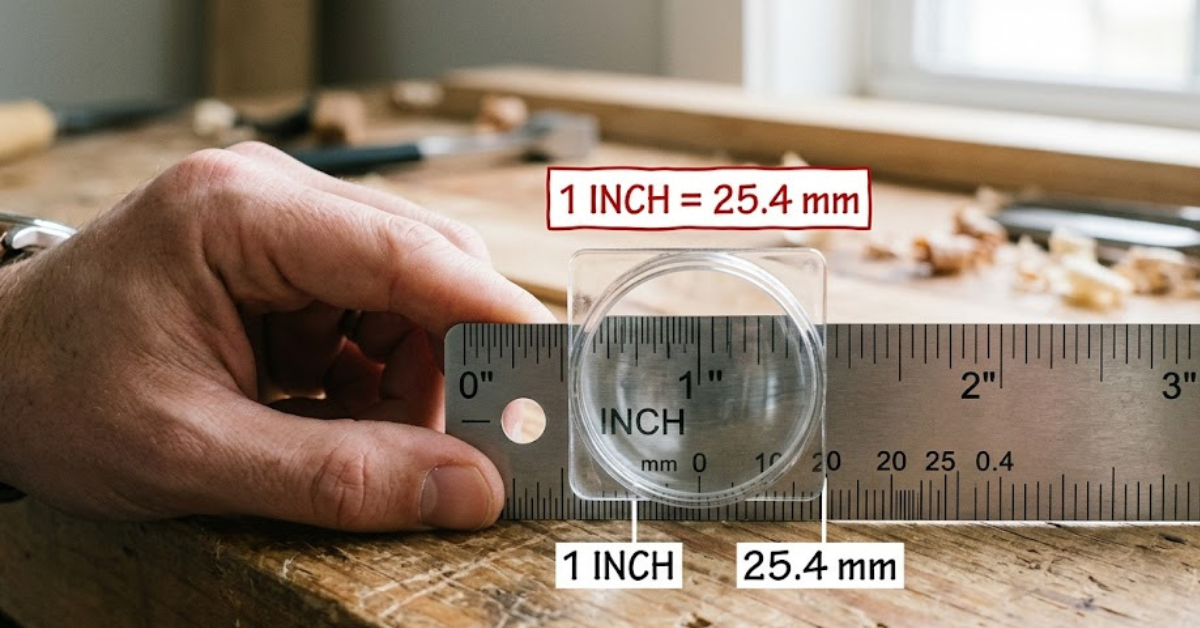
Have you ever looked at a ruler, tape measure, or technical drawing and wondered how many mm in an inch? You’re not alone. Whether you’re working on a DIY project, studying engineering, shopping for hardware, or measuring rainfall, understanding the relationship between inches and millimeters is an essential skill.
The good news is that the conversion is simple and exact. In this guide, you’ll learn how many mm in an inch exactly, how to convert inches to millimeters, how the measurement appears on rulers and tape measures, and common conversions for fractions of an inch.
How Many MM in an Inch Exactly?
The exact answer is:
1 inch=25.4 mm1\text{ inch}=25.4\text{ mm}
This is an internationally recognized standard used in science, engineering, manufacturing, and everyday measurements.
So if you’re asking how many mm in an inch exactly, the answer is always 25.4 millimeters.
Unlike approximate conversions, this value is precise and never changes.
What Is the Difference Between Inches and Millimeters?
Before converting measurements, it helps to understand the two units.
What Is an Inch?
An inch is a unit of length used in the imperial and U.S. customary systems. It is commonly used in:
- Construction
- Manufacturing
- Screen sizes
- Furniture measurements
- Home improvement projects
What Is a Millimeter?
A millimeter is a metric unit of length.
It is commonly used for:
- Engineering drawings
- Mechanical parts
- Precision measurements
- Scientific calculations
- Medical applications
One millimeter equals one-thousandth of a meter.
How to Convert Inches to Millimeters
Converting inches to millimeters is straightforward.
Inch to MM Formula
Millimeters=Inches×25.4\text{Millimeters}=\text{Inches}\times25.4
Example Calculations
- 1 inch = 25.4 mm
- 2 inches = 50.8 mm
- 5 inches = 127 mm
- 10 inches = 254 mm
Simply multiply any inch measurement by 25.4 to get the equivalent value in millimeters.
How Many MM in an Inch on a Ruler?
Many people search for how many mm in an inch on a ruler.
A standard metric ruler displays:
- Centimeters
- Millimeters
Since:
- 1 centimeter = 10 millimeters
- 1 inch = 25.4 millimeters
You’ll notice that an inch extends slightly beyond the 25 mm mark on a metric ruler.
Most rulers include both metric and imperial scales, making it easy to compare measurements directly.
How Many MM in an Inch on a Tape Measure?
The conversion remains the same on a tape measure.
Whether you’re using:
- A construction tape measure
- A sewing tape
- A surveying tape
One inch always equals 25.4 mm.
Many modern tape measures include both inch and metric markings, allowing quick conversions without calculations.
Common Inch Fraction Conversions
Fractional inches are common in construction, carpentry, and engineering.
How Many MM in an Inch and a Half?
1.5 inches × 25.4 = 38.1 mm
So:
1½ inches = 38.1 mm
How Many MM in an Inch and 1/4?
1.25 inches × 25.4 = 31.75 mm
So:
1¼ inches = 31.75 mm
How Many MM in an Inch and a Quarter?
An inch and a quarter is the same as 1¼ inches.
1.25 inches = 31.75 mm
How Many MM in an Inch and 3/4?
1.75 inches × 25.4 = 44.45 mm
So:
1¾ inches = 44.45 mm
These conversions are frequently used in woodworking, plumbing, and machining.
Quick Inch to MM Conversion Chart
Here are some common conversions:
- ¼ inch = 6.35 mm
- ½ inch = 12.7 mm
- ¾ inch = 19.05 mm
- 1 inch = 25.4 mm
- 1¼ inch = 31.75 mm
- 1½ inch = 38.1 mm
- 1¾ inch = 44.45 mm
- 2 inches = 50.8 mm
- 3 inches = 76.2 mm
- 4 inches = 101.6 mm
- 5 inches = 127 mm
- 10 inches = 254 mm
Keeping these common measurements handy can save time during projects.
Why Millimeters Are Important
Millimeters provide greater precision than inches.
That’s why industries such as:
- Engineering
- Automotive manufacturing
- Aerospace
- Electronics
- Medical device production
often rely on millimeters for accurate measurements.
Even a small difference of a few millimeters can affect how parts fit together.
How Many MM in an Inch of Rain?
Rainfall measurements are often converted between inches and millimeters.
Using the standard conversion:
1 inch of rain = 25.4 mm of rain
Meteorological reports outside the United States frequently use millimeters to describe rainfall totals.
For example:
- 0.5 inch of rain = 12.7 milimeters
- 2 inches of rain = 50.8 mm
Using an Inch-to-MM Converter
An online converter can instantly calculate measurements without manual math.
Benefits include:
- Fast results
- Improved accuracy
- Easy handling of decimal values
- Useful for technical work
However, understanding the formula helps you verify calculations and work without internet access.
Common Mistakes When Converting Inches to MM
Avoid these frequent errors:
Rounding Too Early
Using 25 instead of 25.4 can introduce errors, especially in technical projects.
Confusing CM and MM
Remember:
- 1 cm = 10 mm
- 1 inch = 25.4 mm
These are different units.
Ignoring Fractions
Fractional inch measurements should be converted carefully to maintain precision.
Tips for Remembering the Conversion
Try these simple memory aids:
- Remember the number 25.4.
- Think of 25.4 as the “magic conversion number.”
- Save a quick conversion chart on your phone.
- Use a calculator for complex measurements.
With practice, inch-to-millimeter conversions become second nature.
FAQs
How many mm in 1inch?
There are exactly 25.4 millimeters in one inch.
How many mm in 1inch exactly?
The exact international standard is 25.4 mm per inch.
How many mm in 1inch on a ruler?
One inch corresponds to 25.4 millimeters on a ruler.
How many mm in 1inch on a tape measure?
The conversion remains the same: 1 inch equals 25.4 mm.
How many mm in 1inch and a half?
One and a half inches equals 38.1 mm.
How many mm in 1inch and 1/4?
One and one-quarter inches equals 31.75 mm.
How many mm in 1inch and 3/4?
One and three-quarter inches equals 44.45 mm.
How many mm in 1inch of rain?
One inch of rainfall equals 25.4 millimeters of rainfall.
Why is an inch equal to 25.4mm?
The inch was internationally standardized in 1959 as exactly 25.4 millimeters to ensure consistency worldwide.
Is 25mm the same as 1inch?
No. One inch equals 25.4 mm, so 25 mm is slightly less than one inch.
Conclusion
Understanding how many mm in an inch is a valuable skill for everything from DIY projects and construction work to engineering and everyday measurements. Since 1 inch equals exactly 25.4 millimeters, converting between the imperial and metric systems is straightforward and reliable.
Whether you’re reading a ruler, using a tape measure, checking rainfall data, or converting fractional inches like 1¼ inches or 1¾ inches, knowing this simple conversion can help you measure accurately and avoid costly mistakes. Keep the formula handy, practice common conversions, and you’ll be able to switch between inches and millimeters with confidence.