Understanding how to convert km to mi can make everyday tasks much easier, especially when traveling, running, cycling, or reading international maps. Since different countries use different measurement systems, knowing the relationship between kilometers and miles helps you avoid confusion and calculate distances quickly.
In this guide, you’ll learn the simplest conversion formulas, practical examples, and useful pace calculations. Whether you need to convert a short running distance or a long road trip measurement, this article covers everything in a clear and easy-to-follow way.
What Does KM to MI Mean?
Kilometers and miles are both units used to measure distance, but they belong to different systems.
- Kilometers are part of the metric system
- Miles are part of the imperial system
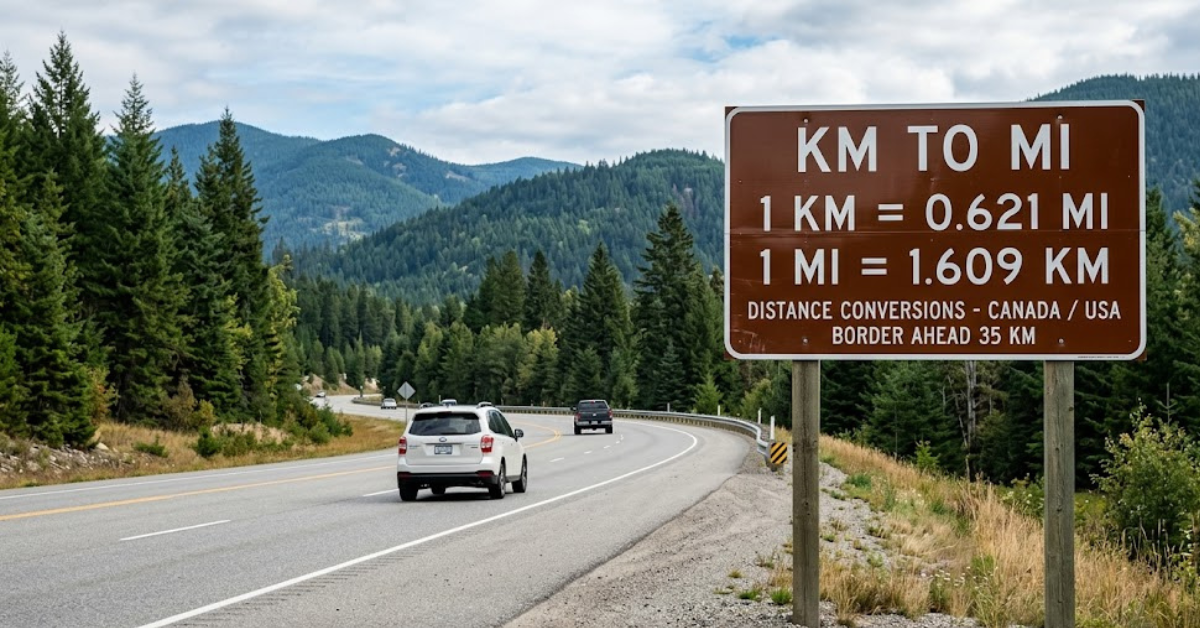
The basic conversion looks like this:
1 kilometer=0.621371 miles1\ \text{kilometer} = 0.621371\ \text{miles}
That means one kilometer is slightly more than half a mile.
Simple Formula to Convert Kilometers to Miles
The easiest way to calculate distance is by multiplying kilometers by 0.621371.
Miles=Kilometers×0.621371\text{Miles} = \text{Kilometers} \times 0.621371
For quick estimates, many people simply multiply by 0.62.
For example:
- 10 kilometers × 0.62 ≈ 6.2 miles
- 50 kilometers × 0.62 ≈ 31 miles
This shortcut works well for daily use.
Common Distance Conversion Examples
1 km to mi
One kilometer equals approximately 0.62 miles.
2 km to mi
Two kilometers converts to around 1.24 miles.
3 km to mi
Three kilometers is roughly 1.86 miles.
10 km to mi
Ten kilometers equals approximately 6.21 miles.
12 km to mi
Twelve kilometers converts to about 7.46 miles.
20 km to mi
Twenty kilometers equals roughly 12.43 miles.
21 km to mi
Twenty-one kilometers is approximately 13.05 miles, which is close to a half marathon distance.
30 km to mi
Thirty kilometers converts to around 18.64 miles.
50 km to mi
Fifty kilometers equals approximately 31.07 miles.
80 km to mi
Eighty kilometers converts to about 49.71 miles.
100 km to mi
One hundred kilometers equals approximately 62.14 miles.
140 km to mi
One hundred forty kilometers converts to roughly 86.99 miles.
160 km to mi
One hundred sixty kilometers equals around 99.42 miles.
200 000 km to mi
Two hundred thousand kilometers converts to approximately 124,274 miles.
300 000 km to mi
Three hundred thousand kilometers equals roughly 186,411 miles.
Understanding KM to MI Pace
Runners and cyclists often need pace conversions when training with apps or international race data.
A kilometer pace measures how long it takes to travel one kilometer, while mile pace measures the time for one mile. Since a mile is longer, mile pace numbers are usually higher.
Here’s the relationship:
Mile Pace=Kilometer Pace×1.60934\text{Mile Pace} = \text{Kilometer Pace} \times 1.60934
For example:
- A 5-minute kilometer pace equals roughly 8:03 per mile
- A 6-minute kilometer pace equals about 9:39 per mile
This helps runners compare training speeds across different measurement systems.
Why Distance Conversion Matters
Knowing how to convert measurements is useful in many situations:
- International travel
- Fitness tracking
- Marathon training
- Road navigation
- Vehicle speed calculations
- Educational and scientific work
Whether you’re reading GPS directions or joining a race abroad, understanding both units saves time and reduces mistakes.
Easy Tips for Faster Conversion
Here are a few practical ways to simplify calculations:
- Memorize the number 0.621371
- Use 0.62 for quick estimates
- Round numbers only when precision isn’t critical
- Save common conversions in your phone
- Practice with familiar distances
After a while, many conversions become easy to estimate mentally.
KM to MI Pace Chart Basics
Although athletes often use dedicated apps, understanding common pace comparisons can still help.
Examples include:
- 4 min/km ≈ 6:26 min/mi
- 5 min/km ≈ 8:03 min/mi
- 6 min/km ≈ 9:39 min/mi
These benchmarks are especially useful for runners preparing for international races.
Frequently Asked Questions
How many miles are in 1 kilometer?
One kilometer equals approximately 0.621 miles.
What is the fastest way to convert kilometers into miles?
Multiply the number of kilometers by 0.62 for a quick estimate.
Is 10 kilometers equal to 6 miles?
Ten kilometers is slightly more than 6 miles, at approximately 6.21 miles.
Why do runners convert kilometer pace to mile pace?
Different countries and race organizers use different measurement systems, so pace conversion helps compare performance accurately.
How accurate is the 0.62 shortcut?
It’s very close for everyday use, though the exact factor is 0.621371.
How many miles is a half marathon?
A half marathon is approximately 13.1 miles or 21 kilometers.
Conclusion
Learning how to handle km to mi conversion is a practical skill that benefits travelers, athletes, students, and drivers alike. With a simple formula and a few common examples, converting distances becomes quick and intuitive.
From race training to long-distance travel planning, understanding kilometers and miles helps you interpret measurements confidently. Keep practicing with everyday distances, and soon you’ll be able to estimate conversions naturally without needing a calculator every time.