
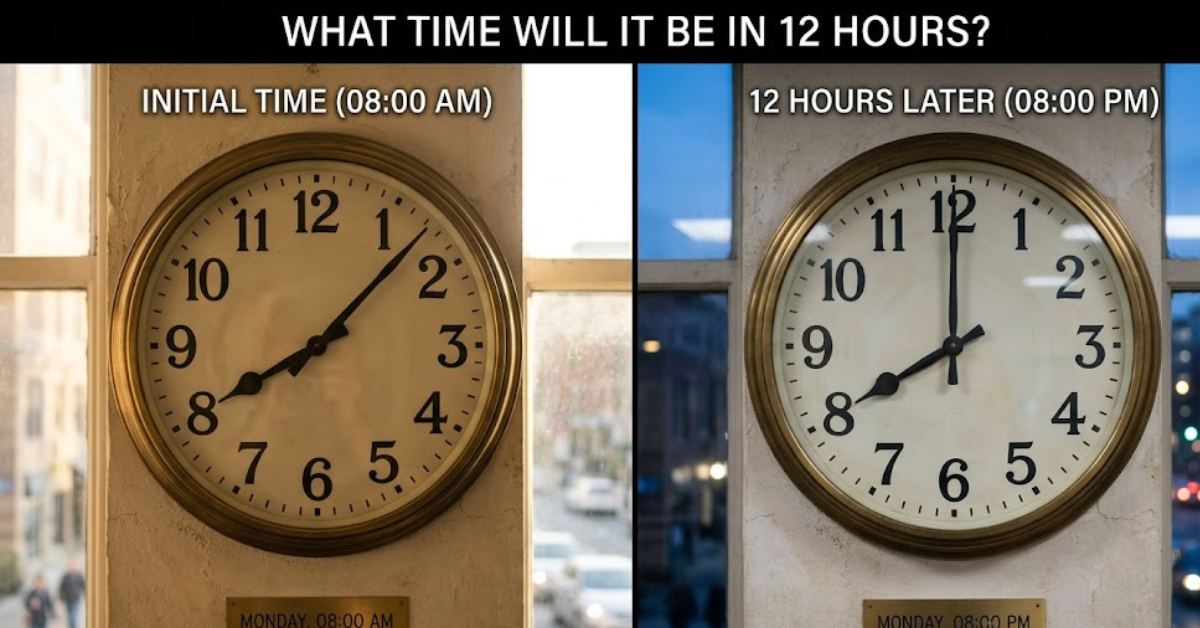
Time calculations are something most people deal with every day, yet they can still become confusing surprisingly fast. Whether you’re setting an alarm, planning a trip, scheduling work, or tracking an event across time zones, many people search online asking, “what time will it be in 12 hours?”
The good news is that calculating future time is easier than it looks. Once you understand the basic process, you can quickly determine future hours and minutes without needing a complicated calculator.
How to Calculate What Time It Will Be in 12 Hours
To figure out what time it will be in 12 hours from now, simply add 12 hours to the current time.
For example:
- If it’s 6:00 AM now, it will be 6:00 PM in 12 hours.
- If it’s 8:00 PM now, it will be 8:00 AM tomorrow.
- If it’s midnight, 12 hours later will be noon.
Because 12 hours is exactly half of a full day, AM and PM switch automatically.
Why 12-Hour Time Calculations Matter
People search for future time calculations for many reasons, including:
- Travel planning
- Sleep schedules
- Shift work
- Medication reminders
- Gaming events
- International meetings
Simple calculations become especially important when crossing into the next day.
What Time Will It Be in 12 Hours From Now?
The exact answer depends on your current local time.
Here’s a quick example:
- Current time: 9:00 AM
- Add 12 hours
- Result: 9:00 PM
Another example:
- Current time: 11:00 PM
- Add 12 hours
- Result: 11:00 AM tomorrow
This is why searches like “what time will it be in 12 hours today” are common. The answer may fall on either the same day or the next calendar day.
What Time Will It Be in 12 Hours and 30 Minutes?
Adding extra minutes works the same way.
Example:
- Current time: 4:00 PM
- Add 12 hours = 4:00 AM
- Add 30 minutes = 4:30 AM
The process becomes easier if you separate the hours and minutes into steps.
Quick Formula
- Add 12 hours
- Add remaining minutes
- Adjust for AM or PM
This method works for all future time calculations.
Examples With Additional Minutes
Many online searches involve slightly different time combinations. Here are some easy examples.
What Time Will It Be in 12 Hours and 10 Minutes?
- Current time: 7:00 AM
- Result: 7:10 PM
Time Will It Be in 12 Hours and 15 Minutes?
- Current time: 1:30 PM
- Result: 1:45 AM
What Time Will It Be in 12 Hours and 20 Minutes?
- Current time: 10:00 PM
- Result: 10:20 AM tomorrow
What Time Will It Be in 12 Hours and 25 Minutes?
- Current time: 5:15 PM
- Result: 5:40 AM
Time Will It Be in 12 Hours and 35 Minutes?
- Current time: 2:00 PM
- Result: 2:35 AM
What Time Will It Be in 12 Hours and 45 Minutes?
- Current time: 9:30 AM
- Result: 10:15 PM
Breaking the calculation into simple steps prevents mistakes.
Understanding AM and PM Changes
One reason people become confused during time calculations is the AM/PM switch.
Here’s the simple rule:
- AM becomes PM after 12 hours
- PM becomes AM after 12 hours
Examples:
- 3:00 AM → 3:00 PM
- 8:00 PM → 8:00 AM
Because 12 hours represents half a day, the opposite time period always applies.
What Time Will It Be in 12 Hours EST?
Eastern Standard Time calculations follow the same method.
If the current EST time is:
- 7:00 PM
- Then 12 hours later will be 7:00 AM
People often search this phrase when coordinating schedules across different regions or countries.
States Using Eastern Time
Eastern Time includes places such as:
- New York
- New Jersey
- Michigan
- Florida
- Virginia
Always check whether daylight saving time is active because that may affect labels like EST or EDT.
Why Future Time Searches Are So Common
Modern life depends heavily on scheduling. Time calculations help people coordinate activities across cities, countries, and digital platforms.
Common reasons people search future time questions include:
- Planning meetings
- Tracking online events
- Setting reminders
- Scheduling deliveries
- Managing work shifts
- Coordinating international calls
Even simple questions like “what time will it be in 12 hours?” can become important during busy schedules.
Easy Mental Trick for Adding 12 Hours
A simple shortcut is to flip the AM or PM without changing the numbers.
Example:
- 5:00 AM → 5:00 PM
- 10:00 PM → 10:00 AM
Then add any remaining minutes separately.
This method works because a full 12-hour jump lands at the same clock number with the opposite half of the day.
Common Mistakes When Calculating Time
People often make errors when:
- Forgetting AM/PM changes
- Ignoring the next day
- Mixing time zones
- Adding minutes incorrectly
The easiest way to avoid mistakes is to calculate the hours first and then handle the minutes afterward.
FAQs
What time will it be in 12 hours from now?
Add 12 hours to your current local time. AM changes to PM, or PM changes to AM.
What time will it be in 12 hours and 30 minutes?
Add 12 hours first, then add 30 minutes.
Why does the day sometimes change?
If the current time is later in the day, adding 12 hours may move the result into the next calendar day.
What time will it be in 12 hours EST?
Take the current Eastern Time and add 12 hours.
Is adding 12 hours difficult?
No. In most cases, you simply switch AM to PM or PM to AM while keeping the same hour number.
How do I calculate future time quickly?
Add the hours first, then add the minutes separately.
Conclusion
Learning how to calculate “what time will it be in 12 hours” is a useful everyday skill that can simplify scheduling, travel, work planning, and daily routines. Whether you’re calculating 12 hours exactly or adding extra minutes, the process becomes easy once you understand the AM and PM switch.
With a few simple tricks and step-by-step thinking, you can quickly determine future times without confusion or mistakes.