
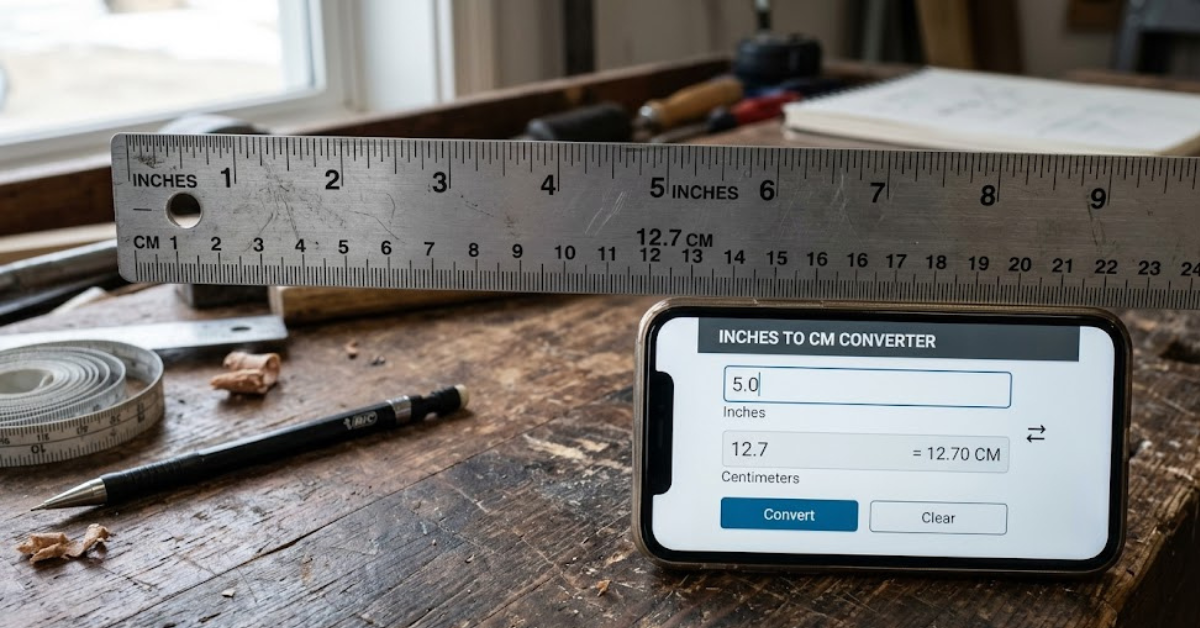
If you’ve ever tried to measure something and got stuck between inches and centimeters, you’re not alone. This is a common challenge in daily life, especially when dealing with international sizing, shopping, or DIY projects.
A quick conversion tool helps you switch between imperial and metric units easily, saving time and avoiding mistakes.
In this guide, you’ll learn how the conversion works, how to use simple formulas, and where it is commonly applied.
What Is an Inch to CM Conversion Tool?
An inch-to-centimeter conversion tool is used to convert measurements from the imperial system into the metric system.
Different countries use different units, so this conversion helps bridge that gap.
The basic relationship is:
1 inch = 2.54 centimeters
So any tool or calculator simply multiplies the inch value by 2.54.
How Inch to CM Conversion Works
The logic behind conversion is very simple.
Formula:
Centimeters = Inches × 2.54
Example:
10 inches × 2.54 = 25.4 cm
This formula is used in every digital or manual conversion method.
Using an Online Conversion Calculator
A digital conversion calculator allows instant results without manual math.
You just enter the value in inches, and the result appears in centimeters immediately.
These tools are commonly used in:
- construction work
- clothing size checks
- furniture measurements
- school and academic tasks
They are preferred because they reduce errors and save time.
Feet and Inches to CM Conversion
Sometimes measurements include both feet and inches, which requires an extra step.
Process:
- Convert feet into inches (1 foot = 12 inches)
- Add total inches
- Multiply by 2.54
This method is useful for:
- height measurement
- interior design
- medical records
Combined converters handle both units automatically, making the process easier.
Common Inch to CM Conversions
Here are frequently used conversions:
- 2 inches = 5.08 cm
- 8 inches = 20.32 cm
- 9 inches = 22.86 cm
- 14 inches = 35.56 cm
- 21 inches = 53.34 cm
- 25 inches = 63.5 cm
- 39 inches = 99.06 cm
- 42 inches = 106.68 cm
- 54 inches = 137.16 cm
- 70 inches = 177.8 cm
- 71 inches = 180.34 cm
- 80 inches = 203.2 cm
These values are often used for quick reference in daily tasks.
Clothing and Chest Measurement Conversion
In fashion and tailoring, chest measurements are often converted for sizing accuracy.
Example:
- 40-inch chest = 101.6 cm
- 44-inch chest = 111.76 cm
This helps when ordering clothes from international brands.
Why Use a Digital Converter?
Online tools for unit conversion are popular because they are:
- fast and accurate
- easy to access
- free to use
- suitable for multiple purposes
They are useful for both personal and professional tasks.
Most Common Search Patterns
People often look up specific conversions such as:
- 2 inches to cm
- 8 inches to cm
- 14 inches to cm
- 21 inches to cm
- 25 inches to cm
- 39 inches to cm
- 42 inches to cm
- 54 inches to cm
- 70 inches to cm
- 80 inches to cm
These usually come from real-world needs like shopping, fitness, or construction.
Benefits of Using a Conversion Tool
Using a measurement converter helps you:
- avoid manual calculation errors
- save time
- improve accuracy
- match international standards
- simplify everyday tasks
FAQs
1. What is the formula for inch to cm conversion?
Multiply inches by 2.54.
2. Can I calculate it manually?
Yes, but a calculator is faster and more accurate.
3. Why do we need unit conversion?
Because different countries use different measurement systems.
4. Is 1 inch always 2.54 cm?
Yes, it is a fixed international standard.
5. Where is this conversion most used?
In clothing, construction, education, and everyday measurements.
Conclusion
Converting inches to centimeters is simple once you understand the basic formula. Whether you use a digital tool or calculate manually, the process always relies on multiplying by 2.54.
With this knowledge, you can handle measurements more easily in shopping, work, and daily life without confusion.