
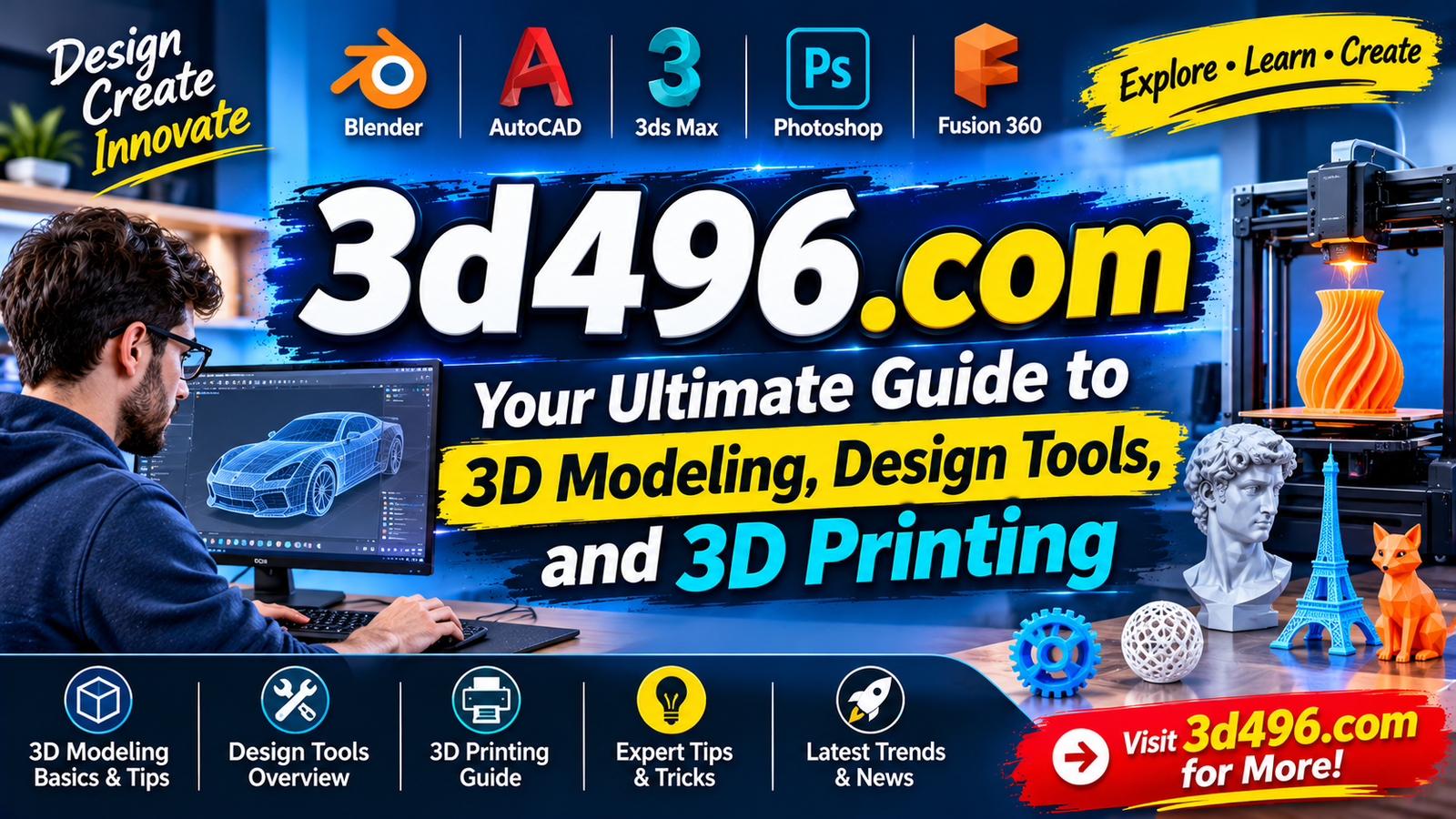
The world of digital creativity is evolving rapidly, and 3D technology has become an important part of modern industries. From video game development and animation to architecture, product design, and manufacturing, 3D modeling and printing are transforming how people turn creative ideas into reality. For beginners, professionals, and technology enthusiasts looking for useful information about these subjects, 3d496.com is a website worth exploring.
3d496.com focuses on providing informative resources, practical guides, and insights related to 3D modeling, design tools, and 3D printing. Whether someone wants to understand the basics of creating digital objects or improve their existing design skills, the platform offers content covering different aspects of 3D creation.
What Is 3d496.com?
3d496.com is an online resource dedicated to 3D modeling, creative design tools, and printing techniques. Its primary purpose is to help readers explore the growing world of three-dimensional technology through educational articles and practical information.
The website covers subjects suitable for different experience levels. Beginners can explore introductory guides to understand basic concepts, while experienced designers can discover articles about advanced techniques, software, and creative workflows.
Some of the main topics featured on 3d496.com include:
- 3D modeling techniques and tutorials.
- Digital design software and creative tools.
- 3D printing methods and materials.
- Product development and industrial design.
- Virtual reality and 3D design.
- Printing tips, troubleshooting, and practical guides.
This variety makes the website relevant to readers interested in learning more about modern digital design.
Exploring the World of 3D Modeling
3D modeling is the process of creating three-dimensional digital objects using specialized computer software. Unlike traditional two-dimensional drawings, 3D models represent objects with height, width, and depth.
These models can be used in several industries, including entertainment, engineering, architecture, education, and manufacturing.
For example, game developers use 3D models to create characters, environments, and objects. Architects use digital models to present building concepts, while product designers develop virtual prototypes before manufacturing physical products.
Readers exploring 3d496.com can learn about different modeling concepts and techniques that help improve their understanding of digital creation.
Important 3D modeling techniques include:
- Polygon Modeling: Creating objects using connected geometric shapes.
- Sculpting: Developing detailed digital objects using virtual sculpting tools.
- NURBS Modeling: Creating smooth and precise curved surfaces.
- Procedural Modeling: Generating models through rules and algorithms.
- CAD Modeling: Designing accurate objects for engineering and manufacturing.
Understanding these methods can help creators choose suitable approaches for their individual projects.
Discovering Useful 3D Design Tools
Choosing the right software is an important part of any successful 3D design project. Different applications offer different features, workflows, and capabilities.
Some programs are designed for beginners, while others provide advanced functionality for professional designers, engineers, and digital artists.
Popular 3D design applications include Blender, Autodesk Maya, Autodesk 3ds Max, SketchUp, and Fusion.
When selecting design software, users should consider several factors:
- Ease of Use: Beginners should look for software with accessible interfaces and helpful learning resources.
- Features: Choose applications that support the tools required for specific projects.
- Performance: Make sure the software works smoothly with available computer hardware.
- Compatibility: Consider supported file formats and integration with other applications.
- Budget: Compare free, subscription-based, and professional software options.
Exploring design-related articles on 3d496.com can help readers understand different tools and develop better software-selection strategies.
Understanding the Basics of 3D Printing
3D printing is another important area of modern digital manufacturing. Also known as additive manufacturing, this technology creates physical objects by building material layer by layer from a digital design.
Traditional manufacturing often involves cutting or removing material, whereas 3D printing adds material according to the requirements of a digital model.
This technology is useful for creating prototypes, customized products, educational models, replacement components, and decorative objects.
Common 3D printing technologies include:
- Fused Deposition Modeling (FDM): Uses melted filament to build objects layer by layer.
- Stereolithography (SLA): Uses light to cure liquid resin into solid shapes.
- Selective Laser Sintering (SLS): Uses a laser to fuse powdered materials.
- Digital Light Processing (DLP): Uses projected light to cure resin.
Each technology offers different advantages depending on the material, budget, required detail, and intended application.
Choosing the Right Materials for 3D Printing
Material selection plays a major role in determining the quality, strength, flexibility, and appearance of a printed object.
Different materials are suitable for different applications. Beginners often start with accessible filament options, while professional users may require specialized materials for demanding projects.
Some commonly used 3D printing materials include:
- PLA: A popular beginner-friendly filament that is relatively easy to print.
- ABS: A durable thermoplastic used for various functional components.
- PETG: Offers a useful combination of strength and flexibility.
- TPU: A flexible material suitable for rubber-like printed objects.
- Resin: Commonly used when detailed surfaces and fine features are important.
Before selecting a material, users should consider printing temperature, durability, flexibility, environmental conditions, and printer compatibility.
Learning about these materials can help creators avoid unnecessary printing problems and achieve better results.
Practical Tips for Improving Your 3D Design Skills
Developing strong 3D design skills requires practice, patience, and continuous learning. Even experienced designers regularly explore new techniques and software features to improve their work.
Here are some useful tips for anyone interested in becoming better at 3D modeling and printing:
- Start With Simple Projects: Practice creating basic shapes before moving toward complicated objects.
- Learn Essential Shortcuts: Understanding software shortcuts can improve productivity.
- Study Real-World Objects: Observe shapes, proportions, textures, and dimensions.
- Experiment With Materials: Test different printing materials to understand their characteristics.
- Practice Regularly: Consistent practice helps develop technical confidence.
- Review Your Work: Identify design mistakes and make improvements.
- Explore Educational Resources: Read tutorials, guides, and articles to discover new techniques.
Websites such as 3d496.com can complement practical learning by introducing readers to different topics in the 3D design industry.
Who Can Benefit From 3d496.com?
One of the interesting aspects of 3D technology is its usefulness across many professional and creative fields. The information available through 3d496.com may appeal to several types of readers.
These include:
- Beginners: People interested in understanding the fundamentals of 3D modeling.
- Students: Learners exploring digital design, engineering, and manufacturing.
- Graphic Designers: Creative professionals interested in expanding their digital skills.
- 3D Artists: Individuals working with animation, characters, environments, and visual effects.
- Entrepreneurs: Business owners exploring prototyping and customized product development.
- Hobbyists: People interested in creating personal projects with 3D printers.
By exploring different subjects, readers can identify useful techniques and discover areas they want to learn more about.
The Future of 3D Modeling and Printing
The future of 3D technology looks promising as software, hardware, and manufacturing methods continue to improve. Artificial intelligence, virtual reality, automation, and advanced materials are creating new opportunities for designers and manufacturers.
AI-powered tools are helping users automate certain design tasks, generate creative concepts, and improve digital workflows. Virtual reality is making it possible to interact with three-dimensional environments in more immersive ways.
Meanwhile, advances in additive manufacturing are expanding the possibilities for producing customized components, prototypes, and specialized products.
These developments make it increasingly valuable for students, professionals, and enthusiasts to stay informed about new technologies.
Following educational resources such as 3d496.com can help readers explore relevant topics and understand how the industry is developing.
Why Explore 3d496.com?
Finding reliable and understandable information is essential when learning a technical subject. 3d496.com brings together content related to modeling, design tools, and printing guides in one online destination.
Its topic coverage provides readers with opportunities to explore different areas of digital creation without limiting themselves to a single discipline.
Whether someone is researching modeling software, learning about printing materials, or exploring modern design techniques, the website offers a starting point for discovering useful information.
Readers should always evaluate software recommendations, verify technical specifications, and practice new techniques using appropriate tools.
Final Thoughts
3D technology is changing the way people design, develop, and manufacture products. From digital modeling and animation to prototyping and additive manufacturing, these technologies provide exciting opportunities for creativity and innovation.
3d496.com is an online resource focused on helping readers explore these subjects through articles, guides, and educational content. Its coverage of 3D modeling, design tools, and printing techniques makes it relevant to beginners, students, professionals, and technology enthusiasts.
If you want to expand your knowledge of digital design, understand 3D printing, or discover new modeling techniques, exploring 3d496.com can be a useful starting point on your creative learning journey.