
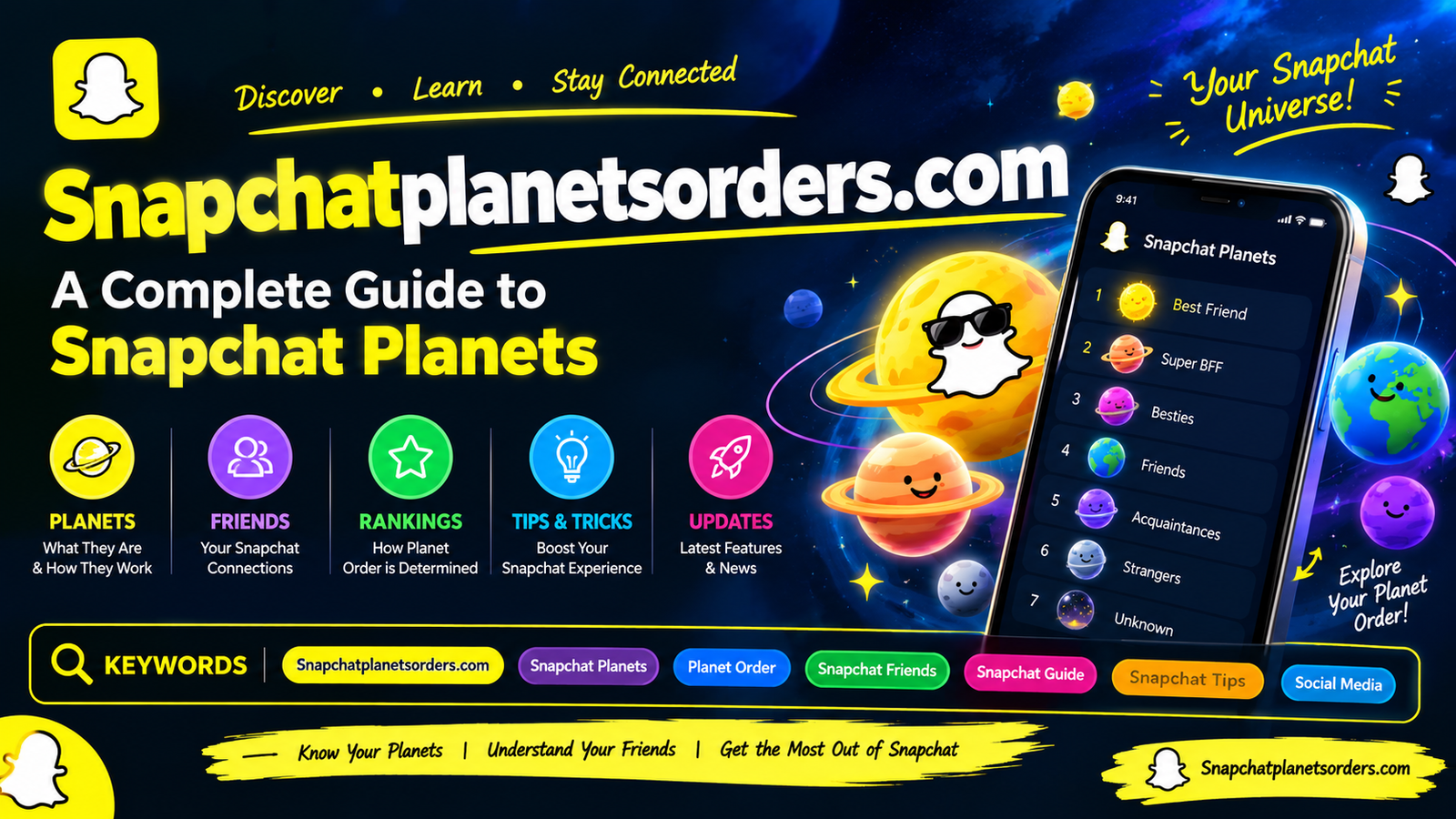
If you are searching for Snapchatplanetsorders.com, you are probably interested in understanding Snapchat Planets, the Friend Solar System, and what each planet means. Snapchat has turned its Best Friends feature into a fun solar-system-style experience for Snapchat+ users. Instead of simply showing a list of close friends, Snapchat represents the top eight positions with planets, from Mercury to Neptune.
The concept is simple: you are the Sun, and your friends appear as planets around you. The closer the planet is to the Sun, the higher that friend ranks in the particular Friend Solar System. Below is a complete guide to the Snapchat planets order, their meanings, how the feature works, and answers to common questions.
What Are Snapchat Planets?
Snapchat Planets, also known as the Friend Solar System, is a feature associated with Snapchat+. It represents a person’s position in another user’s Best Friends list through a planet.
Snapchat’s official support explains that Best Friends are among the eight people you Snap and Chat with the most. When the Solar System feature is enabled, tapping the Best Friends badge can show which planet you represent in that friend’s Solar System.
The system follows the same general order as the real solar system. Mercury is first, followed by Venus, Earth, Mars, Jupiter, Saturn, Uranus, and Neptune.
Snapchat Planets Order List
Here is the complete Snapchat Planets order from the closest position to the farthest:
- Mercury – #1 Best Friend
- Venus – #2 Best Friend
- Earth – #3 Best Friend
- Mars – #4 Best Friend
- Jupiter – #5 Best Friend
- Saturn – #6 Best Friend
- Uranus – #7 Best Friend
- Neptune – #8 Best Friend
The important thing to remember is that these planets represent ranking positions, rather than a scientific measurement of friendship or a permanent relationship status.
Mercury – Your #1 Best Friend
Mercury is the first planet in the Snapchat Friend Solar System. It represents the person who holds the highest position among the eight friends represented in that particular Solar System.
If you appear as Mercury in someone’s Solar System, it means you currently occupy their #1 position among the friends included in that ranking.
Mercury is the closest planet to the Sun in the real solar system, so Snapchat uses it for the closest friendship position. Your position can change as your interactions with different friends change.
Venus – Your #2 Friend
Venus represents the second position in the Snapchat Planets order.
A person appearing as Venus is ranked immediately after the Mercury position in that friend’s Solar System. You may interact frequently with this person, but another friend currently has a higher ranking.
Venus is the second planet from the Sun in our solar system, which is why it represents the second Snapchat friendship position.
Earth – Your #3 Friend
Earth represents the third position in the Friend Solar System.
If your Bitmoji appears on Earth in someone’s Snapchat Solar System, you occupy the #3 position among their represented Best Friends.
The Earth icon is generally recognizable because of its blue and green appearance. However, the important part of the icon is its ranking—not its colors.
Mars – Your #4 Friend
Mars represents position number four.
This places the friend in the middle of the eight available planet positions. Someone shown as Mars is still within the person’s top eight represented friends, although three other positions rank higher.
The Snapchat planet system therefore provides a quick visual way of understanding where you stand within that person’s Snapchat friendship ranking.
Jupiter – Your #5 Friend
Jupiter represents the fifth position in the Snapchat Planets order.
Jupiter is the fifth planet from the Sun in the real solar system, and Snapchat follows the same sequence for its Friend Solar System.
A Jupiter position means the person is ranked fifth among the eight friends represented in that particular system.
Saturn – Your #6 Friend
Saturn is the sixth planet in Snapchat’s Friend Solar System.
If you appear as Saturn, you currently hold position six among the eight friends included in the ranking.
The Saturn icon is particularly easy to recognize because of its famous planetary rings. However, the visual design is mainly there to make the feature entertaining and easy to understand.
Uranus – Your #7 Friend
Uranus represents the seventh position.
It is one position away from Neptune, the eighth and final planet in the Snapchat ranking.
Being Uranus does not necessarily mean that someone is unimportant as a friend. It simply indicates their current position within the specific Snapchat ranking. Interaction patterns can change, so the position may change over time.
Neptune – Your #8 Friend
Neptune represents the eighth position, making it the final planet in the Snapchat Friend Solar System.
If you are shown as Neptune, you are currently the eighth-ranked person among the friends represented in that Solar System.
Neptune is the farthest of the eight planets from the Sun in the real solar system, making it a natural choice for Snapchat’s eighth position.
How Does the Snapchat Friend Solar System Work?
The basic idea is straightforward. Snapchat evaluates your friendship interactions and identifies the people who are among your most frequently contacted friends. Snapchat’s official documentation says the Best Friends list consists of people you Snap and Chat with the most.
The Solar System then presents these positions using eight planets.
For example:
- Mercury = position #1
- Venus = position #2
- Earth = position #3
- Mars = position #4
- Jupiter = position #5
- Saturn = position #6
- Uranus = position #7
- Neptune = position #8
This makes the ranking much more visual than a traditional list.
How to See Your Snapchat Planet
If you have Snapchat+ and the relevant feature is available on your account, you can generally view a Friend Solar System through a friend’s Friendship Profile.
According to Snapchat’s support information, you can look for the Best Friends badge with a gold ring. Tapping the badge can show which planet you occupy in that friend’s Solar System.
Snapchat also notes that Solar System is off by default for first-time subscribers and can be enabled through the Snapchat+ feature management settings.
If you cannot see the feature, check whether Snapchat+ is active, whether Solar System is enabled, and whether your app is up to date.
Does Your Snapchat Planet Stay the Same?
No. Your Snapchat planet can change.
The Friend Solar System represents a ranking based on your interactions, so your position is not necessarily permanent. If you interact more frequently with one person, their position can become higher relative to other friends.
For example, someone who appears as Jupiter today could potentially move toward Mars, Earth, Venus, or Mercury as their ranking changes.
This is why you should think of Snapchat Planets as a current ranking rather than a permanent friendship label.
Is the Snapchat Planet Ranking Mutual?
Not necessarily.
Your position in another person’s Solar System is based on their ranking of friends, while your own Solar System is based on your interactions and rankings.
For example, you might be Mercury in one friend’s Solar System while that same person is Earth in yours. This is possible because each person’s ranking is separate.
Therefore, seeing someone as Mercury in your Solar System does not automatically mean you are Mercury in theirs.
Why Does Snapchat Use Planets?
The Friend Solar System gives Snapchat a playful way to display its Best Friends system.
Instead of presenting friendship rankings as numbers alone, Snapchat uses a familiar solar-system concept. Users can quickly understand that Mercury is closer to the Sun than Neptune, so Mercury represents the higher-ranked position.
This approach also makes the feature more interactive and visually interesting.
Snapchat Planets vs. Real Planetary Order
The Snapchat ranking is inspired by the real solar system, but it should not be confused with astronomy.
The real planetary order is:
Mercury → Venus → Earth → Mars → Jupiter → Saturn → Uranus → Neptune
Snapchat uses exactly this sequence for its eight Friend Solar System positions.
However, Snapchat is not measuring physical distance. The planets are simply visual representations of friendship positions.
Frequently Asked Questions
What is the Snapchat Planets order?
The Snapchat Planets order is Mercury, Venus, Earth, Mars, Jupiter, Saturn, Uranus, and Neptune.
What does Mercury mean on Snapchat?
Mercury represents the #1 position in a friend’s Friend Solar System—the highest-ranked position among the eight represented friends.
What does Neptune mean on Snapchat?
Neptune represents position #8, the final position in the eight-planet Friend Solar System.
Do you need Snapchat+ for Snapchat Planets?
The Friend Solar System is a Snapchat+ feature. Snapchat’s official support documentation identifies Solar System as part of the Snapchat+ experience.
Can my Snapchat planet change?
Yes. Friendship rankings can change as your interaction patterns change, so your planet position is not necessarily permanent.
Can someone have a different planet for me?
Yes. The ranking is specific to each person’s Solar System. Your position in one person’s system does not automatically determine their position in yours.
Final Thoughts
Understanding snapchatplanetsorders.com and the Snapchat Planets system is much easier once you remember one simple rule: you are the Sun, and the eight planets represent positions in your Best Friends ranking.
The order starts with Mercury as #1 and ends with Neptune as #8. Venus, Earth, Mars, Jupiter, Saturn, and Uranus fill the positions in between. Snapchat uses this solar-system theme to turn its Best Friends rankings into a visual and interactive experience.
Most importantly, a planet should not be treated as a permanent judgment about a friendship. Your position reflects the ranking represented by the feature and can change as your Snapchat interactions change.
For the latest feature behavior, Snapchat’s own support documentation is the best reference because Snapchat can change how Snapchat+ features work over time.