
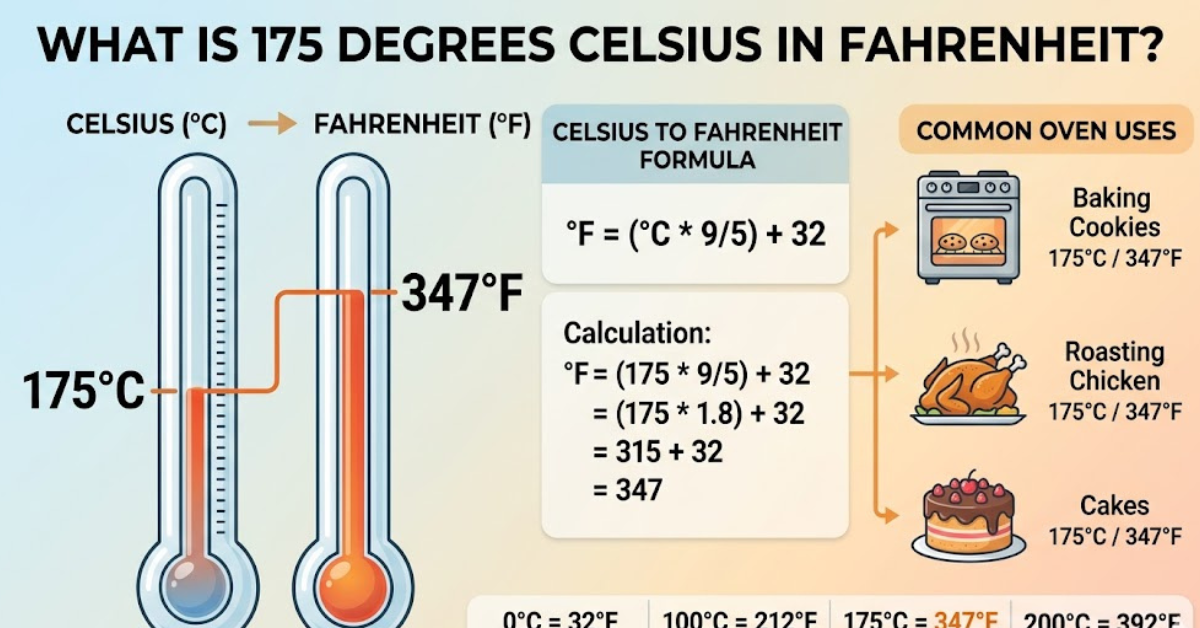
If you’ve ever followed an international recipe, you’ve probably stopped to ask yourself: what is 175 degrees Celsius in Fahrenheit? Cooking temperatures can get confusing when recipes use different measurement systems, especially if your oven displays Fahrenheit while the recipe lists Celsius.
The good news is that converting temperatures is much easier than it seems. Knowing how oven temperatures compare helps you bake more accurately and avoid undercooked or overcooked food. In this guide, you’ll learn the exact Fahrenheit equivalent of 175°C, how to convert it yourself, what this temperature means for fan ovens, and why it’s one of the most commonly used baking temperatures.
What Is 175 Degrees Celsius in Fahrenheit Exactly?
The exact conversion is:
F=(175×95)+32=347F = (175 \times \frac{9}{5}) + 32 = 347F=(175×59)+32=347
So, 175 degrees Celsius equals 347 degrees Fahrenheit.
In everyday cooking, most people round this to 350°F because many ovens don’t display 347°F specifically. Recipes often use rounded temperatures for simplicity.
Why 175°C Is a Common Oven Temperature
175°C is considered a moderate baking temperature. It’s hot enough to cook food evenly while still allowing baked goods to rise properly without burning too quickly.
This temperature is commonly used for:
- Cakes
- Cookies
- Muffins
- Brownies
- Lasagna
- Roasted vegetables
- Chicken dishes
- Casseroles
Professional bakers often prefer moderate temperatures because they create consistent results across different recipes.
Celsius to Fahrenheit Conversion Explained
Understanding the conversion process can help you adjust recipes more confidently.
The formula used is:
F=(C×95)+32F = (C \times \frac{9}{5}) + 32F=(C×59)+32
To convert Celsius into Fahrenheit:
- Multiply the Celsius temperature by 9
- Divide the result by 5
- Add 32
For 175°C:
- 175 × 9 = 1575
- 1575 ÷ 5 = 315
- 315 + 32 = 347°F
Once you understand the formula, converting cooking temperatures becomes much easier.
What Does 175°C Mean for Fan Ovens?
Fan ovens circulate hot air throughout the oven, allowing food to cook faster and more evenly.
Because fan ovens are more efficient, recipes usually recommend reducing the temperature slightly. If a recipe calls for 175°C in a conventional oven, you’ll often set a fan oven to around 155°C–160°C.
This adjustment helps prevent:
- Overbaking
- Dry textures
- Burnt edges
- Uneven cooking
Always check your oven manual because some fan ovens vary slightly in performance.
Is 175°C Considered High Heat?
No, 175°C is generally classified as moderate heat.
Here’s a simple breakdown of oven temperature ranges:
- Low heat: 120°C–150°C
- Moderate heat: 160°C–180°C
- High heat: 190°C and above
Because it sits in the moderate range, 175°C works well for a wide variety of recipes.
Foods That Bake Best at 175°C
Some foods perform especially well at this temperature because it balances browning and internal cooking.
Cakes and Cupcakes
Cakes rise evenly at 175°C without becoming dry on the outside.
Cookies
Cookies baked at this temperature usually develop crisp edges while staying soft inside.
Brownies
Brownies often turn out fudgy and moist with gentle, even baking.
Roasted Vegetables
Vegetables caramelize nicely without burning too quickly.
Pasta Bakes and Casseroles
This temperature allows the center to heat thoroughly while creating a golden top layer.
Tips for Baking at 175°C
To get the best cooking results, follow these simple tips.
Preheat Your Oven
Always let the oven fully heat before placing food inside.
Use the Center Rack
The middle rack typically provides the most balanced heat distribution.
Avoid Opening the Door Repeatedly
Every time you open the oven door, heat escapes and affects cooking consistency.
Use an Oven Thermometer
Some ovens run hotter or cooler than the displayed temperature. A thermometer helps improve accuracy.
Adjust for Fan Ovens
Reduce the temperature slightly if you’re using a fan-assisted oven.
Why Different Countries Use Different Temperature Systems
Temperature systems vary depending on the region.
Most countries use Celsius because it’s part of the metric system. However, the United States still commonly uses Fahrenheit in cooking and baking.
That’s why understanding both scales can make international recipes much easier to follow.
Common Oven Temperatures Near 175°C
To better understand where 175°C fits, here are nearby oven conversions people frequently use:
- 160°C = 320°F
- 170°C = 338°F
- 175°C = 347°F
- 180°C = 356°F
- 190°C = 374°F
These are among the most common baking temperatures used worldwide.
FAQs
What is 175 degrees Celsius in Fahrenheit for baking?
175°C equals 347°F, which is commonly rounded to 350°F in baking recipes.
Is 175°C the same as 350°F?
Almost. Technically, 175°C equals 347°F, but most people round it to 350°F for convenience.
What fan oven setting equals 175°C?
A fan oven setting of around 155°C–160°C is usually equivalent.
Is 175°C good for cakes?
Yes. It’s one of the most commonly recommended temperatures for cakes because it provides even baking.
Why do recipes use Celsius instead of Fahrenheit?
Most countries outside the United States use Celsius as part of the metric system.
Can I bake cookies at 175°C?
Absolutely. Cookies often bake very well at this temperature, producing balanced texture and color.
How long should food cook at 175°C?
Cooking time depends on the recipe, food size, and oven type. Always follow recipe guidelines as a starting point.
Conclusion
Understanding what 175 degrees Celsius in Fahrenheit means can make cooking and baking much less confusing. The exact conversion is 347°F, though most recipes round it to 350°F for convenience.
This moderate oven temperature is ideal for cakes, cookies, casseroles, roasted vegetables, and many other everyday dishes. Once you become comfortable converting between Celsius and Fahrenheit, following international recipes becomes much easier and far more enjoyable.
Whether you’re an experienced baker or just getting started in the kitchen, knowing these temperature conversions helps you cook with greater confidence and accuracy every time.